
Highlighted Items
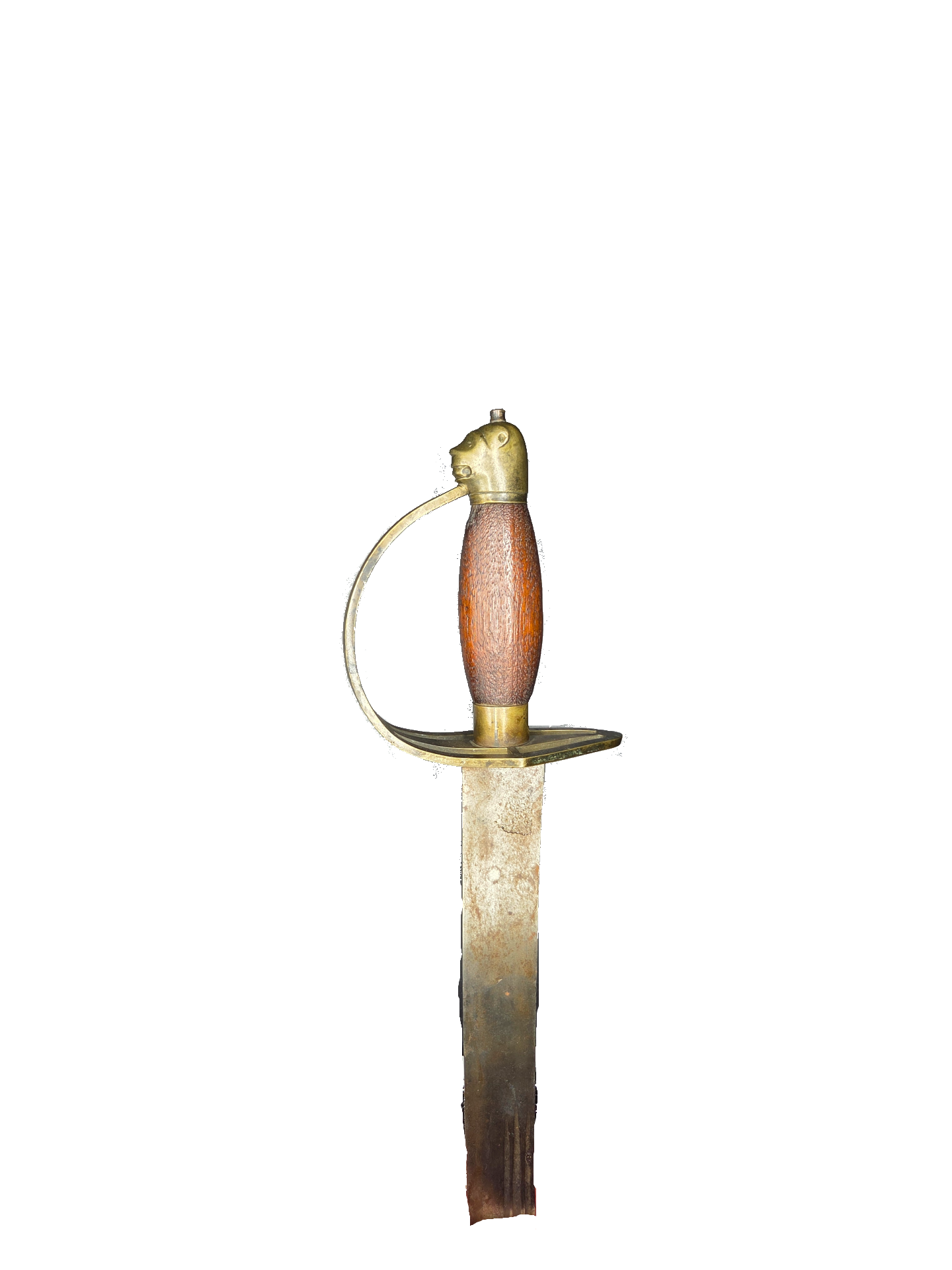
Three nearly identical examples were found in an attic in Elliot, Maine decades ago. See William Guthman, “Colonial Swords of New England: Part I, Man at Arms, Sept/October 1982 page 38.

This is an extremely rare “middling sort,” or middle class, coat of the mid-eighteenth century in an attractive color. Clothing wealthier people survive more often than those of the ordinary men and women who defined the era.
The date is evident in the tailoring. The large cuffs, wide small of the back, and gradual cut back across the belly suggest a Revolutionary Era date. The collar was originally a 1770s-style tab color, but in the 1780s or 1790s it was converted to a rise-and-fall collar for the fashion of that time. If you lift the collar up, you will see the earlier collar integrated into it. It is lined with Beetled linen, a fabric commonly seen on the interior of flame stitch wallets.

The identity of Shorland is not yet known. This seal is not listed in David Burton’s massive three volume set Antique Sealed Bottles and the Families who owned them, 1640-1900. There is a chip on the lip of the bottle.

American Revolutionary Era American “cheesebox” or “single stave” canteen with large rose-heads holding the lapped stave and period initials “MW” scratched into one side. Thousands of similar canteens were made in Hingham Mass for American military use throughout the Revolutionary War. Dia. 7” W. 3.5”
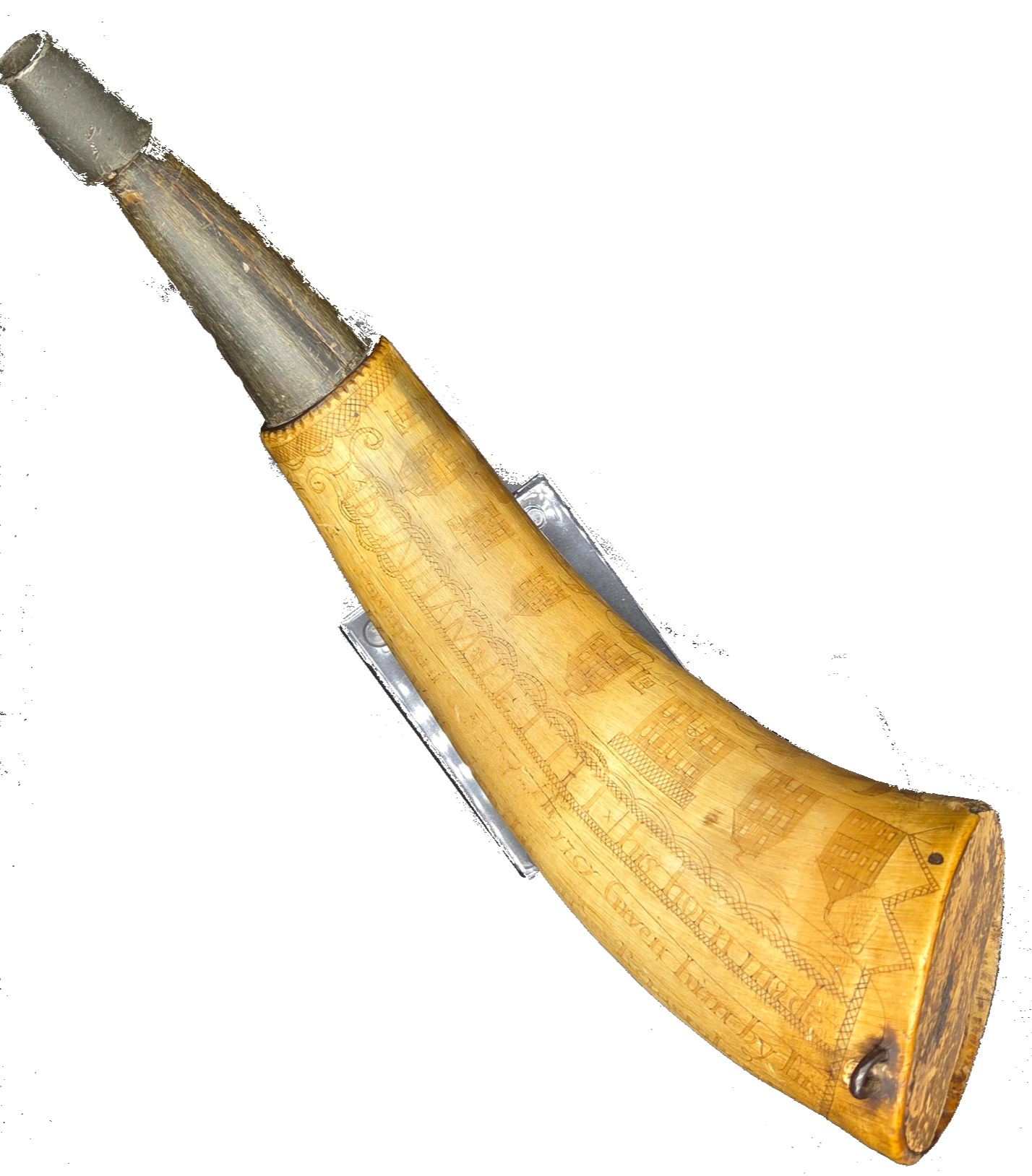
French and Indian War powder horn of Dunham Pettit, dated at Crown Point 19 October, 1761, given to him by his brother John Pettit, a soldier in the Second
Connecticut Regiment at the fort. Overall lg. 13 ¾”
The horn is carved with a streetscape and vines and inscribed
Dunham Pettit, his horn made/At Crown Point Octobr ye 19th 1761 Given him by his/Brother John Pettit when this you see Remember me/Steal not this horn for Fear of Shame for on it is The owners name Dunham Pettit his horn.
Dunham Pettit and John Pettit were brothers from Sharon, Connecticut. When this horn was carved on 19 October 1761, John Pettit of Sharon, Connecticut was serving as a private solider at Crown Point under Captain Thomas Pierce in the Ninth Company of the Second Connecticut Regiment, commanded by Colonel Nathan Whiting of New Haven. Dunham Pettit, his younger brother, was only eight years old, born on 5 October 1754. He may have been serving at Crown Point as a waiter with the army. This horn is engraved by an as-yet unidentified carver, who is known to have produced at least one other horn, and that one for a black soldier named “Prince Negro” and “Gershom Prince.” Made for soldiers building the new English Fort at Crown Point, the Dunham and John Pettit horn suggests the extent of racial integration among New England troops of the French and Indian War.
The association between the two horns also identifies the “Prince Negro” of the Luzerne County horn as the same man who served alongside the Pettit brothers in Pierce’s company of the Second Connecticut at Crown Point. This probably settles a longstanding controversy about whether Prince was free man or enslaved and serving as a soldier or a servant to an officer. He was a soldier, and as a soldier, he was very likely free. The Pettit brothers were part of the garrison that created the British Fort at Crown Point, the largest British fort in North America at the time. In the preceding years of 1759 and 1760, provincial American and British forces defeated the forces of New France and acquired Canada for Great Britain. Only six years earlier, Crown Point, known to the French as Fort St. Frederick, had been the Southernmost bastion of New France in the Northeast. With the peace treaty with France ending the French and Indian War still unsigned (it would take until 1763), the Pettit Brothers and other soldiers worked to convert the site to a Northerly facing fort, designed to prevent a renewal of violence on that frontier.
The activities of the Pettit brothers during the Revolutionary War remain shrouded in uncertainty. Some accounts have Dunham moving to Vermont, while another shows him in Sacket’s Harbor. A Dunham Pettit, almost certainly the same man, gave testimony on behalf of an alleged Tory to the Committee of Safety of Albany New York in 1780. The accused was released on Pettit’s word. One Pettit family history claimed that Dunham “went to Canada at the outbreak of the Revolutionary War.” Apparently, though, as far as the Albany Committee was concerned, Dunham Pettit was a trusted Whig. John Pettit may have become a loyalist. There is a John Pettit in the Loyalist Claims commission files, compensating Americans who remained loyal to the king for losses of their property.
Condition: Fine large horn in pleasing mellow color with a wear from use and a few lighter small scratches.
Collections of the Connecticut Historical Society X (1905): 258-259;
Contact Us
Visits by appointment.